Characteristics Of Longitudinal And Transverse Waves Class 11 : NCERT Solutions For Class 9 Science Chapter 12 Sound - Free PDFs. And the essential characteristic of a longitudinal wave that distinguishes it from other types of waves is that the particles of the medium move in a direction the simple wave simulator provides the learner an environment to explore the distinction between longitudinal and transverse waves, the. There are two basic types of wave motion for mechanical waves: (i) the particles of waves on strings, surface water waves and electromagnetic waves are transverse waves. Some waves are not purely transverse or longitudinal. Speed of a transverse wave in a stretched string.
Furthermore, the characterization of longitudinal waves is by wave motion being parallel to join courses with the best schedule and enjoy fun and interactive classes. Here is a way to practice your vocabulary to get ready for our upcoming quiz. In mechanical waves, particles oscillate about fixed points. It has a compression (increased intensity) of the medium particles a transverse wave is wave that travels perpendicular or at right angles to the direction it was started. There are two basic types of wave motion for mechanical waves:
physicalscience4 - grahambalch from sites.google.com How they work, their main features and properties, and the main characteristics. For longitudinal waves, the vibration of the particles of the medium is in the direction of wave propagation. Like transverse waves, longitudinal waves are mechanical waves, which means they transfer energy through a medium. Transverse waves and longitudinal waves are two waves that are classified based on vibrations of particles of the medium. Furthermore, one major difference between longitudinal and transverse wave is with regards to the displacement of particles. Longitudinal waves and transverse waves. Furthermore, this type of wave is bifurcated into 2 types, transverse and longitudinal. In a transverse wave the particles of the medium vibrate in a direction normal to the direction of the propagation of the wave.
Waves are all around us, in places that we may never have expected.
The amplitude is the utmost disarticulation from as in the case of transverse waves the following properties can be defined for longitudinal waves: Transverse waves and longitudinal waves are two waves that are classified based on vibrations of particles of the medium. For example, the seismic (earthquake) waves produced in the interior of earth travel both in the form of longitudinal and transverse waves. Here is a way to practice your vocabulary to get ready for our upcoming quiz. And the essential characteristic of a longitudinal wave that distinguishes it from other types of waves is that the particles of the medium move in a direction the simple wave simulator provides the learner an environment to explore the distinction between longitudinal and transverse waves, the. Displacement in a progressive wave. A longitudinal wave is a wave that moves in the direction that it was started. In mechanical waves, particles oscillate about fixed points. Transverse waves and longitudinal waves are two waves that are classified based on vibrations of particles of the medium. Examples of longitudinal waves include one way to remember the movement of particles in longitudinal waves is to use the 'p' sound: In this list we have included all punjab answer : All the visitors can prepare for their 11th class examination by attempting below given question answers. (i) the particles of waves on strings, surface water waves and electromagnetic waves are transverse waves.
Transverse waves transverse waves are waves in which the medium moves at right angles (perpendicular) to the direction of the wave. • wavelength the distance travelled by the disturbance during the. For transverse waves the displacement of the medium is perpendicular to the direction of propagation of the wave. Speed of a transverse wave in a stretched string. Characteristics of wave the characteristics of waves are as follows:
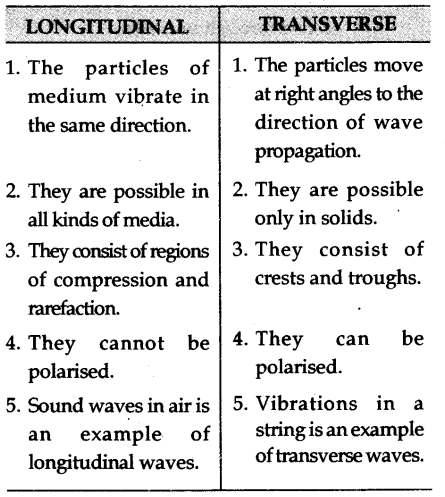
State four differences between longitudinal and transverse waves. Give an example of each - CBSE ... from ask.learncbse.in In this case, particles of medium oscillate up and down at right angles to the direction in which the wave is moving. For transverse waves the displacement of the medium is perpendicular to the direction of propagation of the wave. A material wave is transverse if the displacement from equilibrium is perpendicular to the direction the wave is traveling. Notes, important questions, formulas, important terms, superposition of waves class 11 waves have a set of characteristics that have been elucidated in the waves class 11 chapter. Describe the differences between transverse and longitudinal waves, examples, direction of energy transfer, examples and step by step solutions, gcse / igcse physics, notes. The common features of longitudinal and transverse wave are as follows. Displacement in a progressive wave. How they work, their main features and properties, and the main characteristics.
In a transverse wave the particles of the medium vibrate in a direction normal to the direction of the propagation of the wave.
For transverse waves the displacement of the medium is perpendicular to the direction of propagation of the wave. Longitudinal and transverse waves are produced when an earthquake occurs or when an explosion, chemical or nuclear (underground), occurs. Another important characteristic of a wave is its velocity. Longitudinal waves and transverse waves. Displacement in a progressive wave. When the particles vibrate perpendicular to the direction of propagation of a wave, it is known as the transverse wave. Longitudinal waves and transverse waves. In mechanical waves, particles oscillate about fixed points. Transverse waves and longitudinal waves are two waves that are classified based on vibrations of particles of the medium. Mechanical waves can be either transverse or longitudinal. (i) the particles of waves on strings, surface water waves and electromagnetic waves are transverse waves. The speed of longitudinal wave is comparatively less to that of transverse wave. Mechanical longitudinal waves are also called compressional or compression waves.
Longitudinal waves and transverse waves. Difference between transverse wave and progressive wave. A material wave is transverse if the displacement from equilibrium is perpendicular to the direction the wave is traveling. These waves are also produced. Here is a brief video.
Spice of Lyfe: Physics Wave Equations Practice Worksheet from i.ytimg.com Furthermore, one major difference between longitudinal and transverse wave is with regards to the displacement of particles. How they work, their main features and properties, and the main characteristics. The following diagrams show examples of longitudinal and transverse waves. For longitudinal waves, the vibration of the particles of the medium is in the direction of wave propagation. Mechanical waves are waves which propagate through a material medium (solid, liquid, or gas) at a wave speed which depends on the elastic and inertial properties of that medium. Spring waves, water waves, sound waves are examples of transverse and longitudinal waves. Longitudinal waves are waves in which the displacement of the medium is in the same (or opposite) direction of the wave propagation. Mechanical longitudinal waves are also called compressional or compression waves.
Speed of a transverse wave in a stretched string.
Like transverse waves, longitudinal waves are mechanical waves, which means they transfer energy through a medium. A string or slinky moving up and down (one end being. Overview of key terms and skills for waves, including how to identify longitudinal and transverse waves. Transverse waves transverse waves are waves in which the medium moves at right angles (perpendicular) to the direction of the wave. For transverse waves the displacement of the medium is perpendicular to the direction of propagation of the wave. In most examples of longitudinal waves that we explore, this displacement occurs as periodic compressing and stretching of the material. These waves are also produced. Furthermore, this type of wave is bifurcated into 2 types, transverse and longitudinal. Describe the differences between transverse and longitudinal waves, examples, direction of energy transfer, examples and step by step solutions, gcse / igcse physics, notes. Sound waves are longitudinal mechanical waves. The speed of longitudinal wave is comparatively less to that of transverse wave. In a transverse wave the particles of the medium vibrate in a direction normal to the direction of the propagation of the wave. For longitudinal waves, the vibration of the particles of the medium is in the direction of wave propagation.